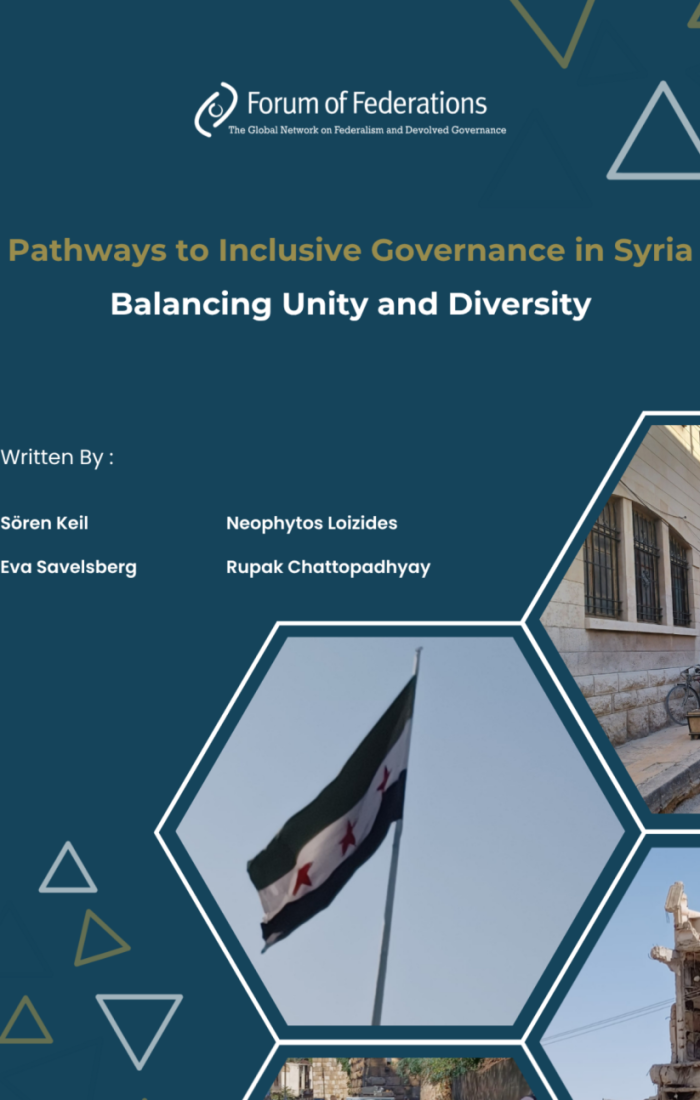
In November 2025, the Forum of Federations launched the Pathways to Inclusive Governance in Syria: Balancing Unity and Diversity report. The report aims contribute to discussions on Syria’s future state structure by grounding them in an assessment of the aspirations of different communities across the country for the future governance arrangements of the new Syrian state.
At the report launch webinar held on November 20, 2025, Syrian commentators from different communities provided their perspectives on the findings of the report and on how to build inclusive governance in Syria.
In this article, Syrian writer and journalist Imad Naddaf provides his refections on the Forum’s report and on the governance arrangements for the new Syrian State.
I was invited to take part in a roundtable that formed part of an online seminar organized by the Forum of Federations in Ottawa on 20 November 2025. On that day, I listened to a summary of a report on Syria’s future, as well as testimonies from Syrian actors who spoke about bloody events that unfolded after the fall of the Assad regime, which were used to advocate for a federal Syria on the assumption that such a project could provide guarantees for the components of the Syrian people.
Since the Forum’s new report covers two main areas of inclusive governance, first, perspectives on the structure of Syria’s future state among different communities in the country, and second, models and options for inclusive governance in other countries that could guide Syria’s transition, it was important to engage carefully with its findings. We therefore followed with particular interest what was presented to us, especially the summary of the report during the online seminar, and felt it necessary to offer a complementary perspective on Syria’s future, even if it diverges from some of the orientations reflected in the report.
I have spent a long period of my life studying Syria’s history in depth and engaging in extensive debates about its national past, present and future, and I have paid a heavy price for the political views I hold, spending nearly ten years in Tadmur and Saydnaya prisons under the former dictatorial rule. On that basis, I consider it a duty to set out my own view, while passing over the well-known historical facts related to the colonial targeting of the region and earlier partition plans, most notably the Sykes-Picot Agreement.
It is sufficient here to recall the findings of the King-Crane Commission, which visited Syria between 10 June and 21 July 1919 and travelled across the country from one end to the other. Its mandate was to ascertain the views of the components of the Syrian people regarding the partition plan that was being proposed at the time.
The commission received 1,863 petitions and met with 442 delegations representing various ethnic and religious communities, and it reached the following conclusions:
- 80.4 percent of the population wanted to preserve the unity of “Greater Syria”, the historic Syria that included Lebanon, Jordan, Palestine and “what is now Syria”
- 73.5 percent wanted full independence, and 59 percent supported a constitutional monarchy under Emir Faysal.[1]
It is also necessary to recall the famous Balfour Declaration of 2 November 1917, which endorsed the establishment of “a national home for the Jewish people”, laying the foundations for the Arab–Israeli conflict and triggering recurrent wars in the region that continue to this day.
These are important historical events whose lessons are worth revisiting, just as the same is true of Bernard Lewis’s more recent project, exposed by Western sources themselves in declassified documents and aimed at promoting schemes that run counter to the aspirations of the Syrian people and its components.
Let me therefore move directly to the contemporary period that concerns us here, which the Forum’s distinguished report addresses in important ways on the basis of painstaking research that merits respect, even where there is disagreement with some of the conclusions or with the international governance experiences used as comparators.
The conflicts that the region has witnessed over the past decades did not stem from any inherent desire not to live together and were not conflicts between societal components. Rather, they were the result of authoritarian military rule seeking to control the resources and destiny of the population.
On this basis, there are two core sets of facts on which there is broad agreement and which require no further proof, both of which relate to: the 2011 revolution and the aftermath of the regime’s fall in 2024.
First: The 2011 Revolution
The popular uprising that broke out in 2011 was not a confrontation between Syria’s religious, ethnic or sectarian components, nor was it an insurrection by one component against another. Rather, it was an expression of solidarity among these components in pursuit of democratic change in the country[2], and the available documentation and evidence indicate that the slogans raised by the early protest waves revolved around two core messages: “The Syrian people are one” and the peaceful nature of the demonstrations.
Numerous studies provide careful evidence that all components participated in the revolution against dictatorial rule, both before and after the uprising began, although fear-mongering by the regime of Bashar al-Assad and his inner circle about potential sectarian reprisals in the event of regime collapse led some minorities to hesitate about full participation.[3]
The Druze community expressed its support for the revolution, and the daughter of the historic leader Sultan Pasha al-Atrash was one of its symbols. In 2023, this community went as far as openly calling for the overthrow of the regime and the construction of a democratic national state, and Druze notables affirmed their support for Syria’s unity after the regime’s fall and their backing for President Ahmed al-Sharaa.
Similarly, since the 1970s, the regime’s prisons have held many detainees from the Alawite and Ismaili communities who advocated a democratic project and rejected the regime’s authoritarian and sectarian practices. Many of these activists belonged to revolutionary and leftist parties, and among the most prominent figures was Dr. Abdelaziz al-Khair, who was detained and disappeared in prison and who represented the Alawite community in the council formed in 2011.
The Christian community also took part in the revolution on the basis of a shared aspiration for a democratic national system. There is ample evidence of sacrifices made in pursuit of this goal, including the role of the prominent Syrian writer Michel Kilo among the leadership of the 2011 revolution and his repeated arrests, the last of which stretched over ten years, along with the activism of Akram al-Antaki, known for his engagement since the Damascus Declaration before the uprising.
While many Muslim participants entered the streets from mosques, those from other components did not mobilize from churches or their own places of worship, yet the facts show that they marched alongside Muslims as they exited mosques, as did secularists and communists. The revolution thus brought together a broad cross-section united around democratic demands.
The uprising also produced a host of other well-known figures from within the Christian component, including activist Akram al-Bunni and his brothers, Ziad Hilal, and activist Bassel Shehadeh, who was killed by Syrian intelligence forces in Homs. There were many others such as Lana Antaki, Boulos Hallak, Sanaa Yazji and Dr. Haitham Saad.
The revolution also witnessed important initiatives involving this component, among them the role of Dr. Jamal Shahid and his son, the Jesuit monk Nabras Shahid. Many read Father Nabras’s book, co-authored with Dr. Hassan Abbas and titled “The Chants of the Syrian Revolution”, and there were Christian clergy who joined the revolution, including Jesuit priests such as Father Frans, who was killed, and Father Paolo, who was abducted by ISIS and held by the group as a bargaining chip in prisoner exchanges with the regime.
It is also essential in this context to highlight the participation of Syriac and Assyrian components, including figures such as Assyrian party leader Gabriel Moshe, as well as many other names and martyrs from these communities. One telling example is the case of the family of lawyer Khalil Ma’touq, a Christian human rights defender and one of the most renowned advocates for political detainees from the revolution, who was arrested by Assad’s intelligence services and subsequently killed in detention.
The regime’s strategy of demonizing the revolution through orchestrated armed attacks and by facilitating military defections was intended to turn the uprising into an armed conflict. Once that militarization took hold, the above-mentioned components scaled back or withdrew their participation, but they did not abandon their demand for a new democratic system.
Second: The Regime’s Fall in December 2024
The regime was toppled on 8 December 2024 by a coalition of armed factions and groups led by Hay’at Tahrir al-Sham. These groups do not share a unified democratic political vision comparable to the roadmap for the transitional period set out by President Ahmed al-Sharaa.
Although the slogans of the transitional phase explicitly refuse to assign collective responsibility to the Alawite community, this underscores that the former dictatorial regime, which oppressed both the majority and minorities alike, never genuinely represented the Alawite sect, even if it sought to mobilize its members in its defence. The grievances voiced today by segments of the Alawite community regarding acts of reprisal against them are therefore legitimate, where such acts have occurred, since the community as such was not responsible for the repression of Syria’s diverse components, even if some of its members played active roles within the regime’s coercive apparatus.
Current governance efforts are striving to find solutions, but debates about partition, federalism or centralization are increasingly at odds with the slogans historically raised by Syria’s components. Under present conditions, the most appropriate model to build on is the unity of the Syrian people on the basis of a democratic national system, which is what Syrians collectively struggled for and what the 2011 revolution called for in its slogans.
Advancing proposals for partition, federalism or even decentralization may become necessary only when coexistence between the components of a given territory has become impossible. Resorting to such solutions is akin to treatment by cauterization, in line with the Arab proverb that “cauterization is the last remedy”, meaning that the wound is burned with fire as a last resort, and Syria has not yet reached that degree of inter-communal conflict. The country is currently experiencing a transitional phase that follows a long war waged in the name of change, as the report’s introduction rightly notes.
The transitional phase, in this sense, can still restore the people to the very slogans for which they paid such a high price. However, this phase requires serious regional and international support so that the new authorities can overcome the legacy of crises left behind by the defunct regime.
It must also be acknowledged that the delay in translating international support for the new state into concrete action has contributed to the outbreak of bloody incidents, which in turn has delayed the emergence of the hoped-for results of such support.
Recognizing this reality means that all actors must work to support a new democratic social contract that restores Syria’s unity and its social solidarity among all components. This cannot be achieved except through a democratic system and full, meaningful representation for all components of the Syrian people.
Imad Naddaf – Syria, Damascus
imadnaddaf@hotmail.com
Endnotes
[1] See Elizabeth F. Thompson, How the West Stole Democracy from the Arabs: The Syrian Arab Congress of 1920 and the Destruction of Its Historic Liberal-Islamic Alliance (Atlantic Monthly Press, an imprint of Grove Atlantic, 154 West 14th Street, New York, NY 10011; distributed by Publishers Group West, groveatlantic.com), Part III, “Syria’s Declaration of Independence,” chap. 7, “The Syrian Congress and the American Commission,” pp. 133–134.
[2] A positive aspect of the report that must be highlighted is the following formulation: groups such as Kurds, Druze and Alawites do not see themselves as “minorities”, but as core components of the state. They consider the term “minority” to diminish their status as fundamental elements and equal citizens in the Syrian state. Therefore, we have refrained from using the term “minorities” when referring to these groups, and have instead used terms such as components or ethnic/religious communities.
[3] Refer to the study on this matter on this link: https://www.ramadan2.com/2025/01/173249.